Weighing Scale Support for POS Software | BManagerHQ
POSfeatures
Weighing Scale Support for POS Software
Content type
Features
Topic
POS
Published
14/09/2026
Keywords
Weighing Scale Support POSweighing scale POS softwarePOS software with weighing scaleweighing scale integration for POSweight-based product sales
Businesses that sell products by weight need a POS system that can handle more than standard quantity-based sales. Grocery stores, supermarkets, food retailers, and other businesses may sell products based on kilograms, grams, or other weight measurements. In these situations, manually entering product quantities can make the sales process slower and increase the possibility of entry mistakes.
BManagerHQ provides Weighing Scale Support as part of its POS functionality, helping businesses incorporate weight-based selling into their sales workflow.
Instead of treating every product as a simple unit-based item, businesses can manage products where the quantity sold is determined by weight.
What Is Weighing Scale Support?
Weighing Scale Support allows a POS system to work with businesses that sell products according to their measured weight.
For example, instead of selling:
1 unit of a product
a business may sell:
2.5 kg of a product
The measured quantity can then be used as part of the sales and billing process. This is particularly useful for businesses where customers regularly purchase products in varying quantities.
Sell Products Based on Weight
Traditional POS systems are often designed around fixed quantities such as:
1 piece
2 pieces
5 pieces
10 pieces
But many retail businesses sell products where the quantity changes from one customer to another.
For example:
retail weighing scale software
grocery POS software
supermarket POS software
weight-based billing
digital weighing scale POS
POS software Bangladesh
500 grams
750 grams
1.25 kg
2 kg
3.5 kg
A weighing-scale-enabled POS workflow is better suited to these situations.
Example
Suppose a grocery store sells a particular product at ৳200 per kilogram.
A customer purchases 1.75 kg.
The sales calculation can be based on:
1.75 kg × ৳200 = ৳350
This allows the business to handle variable quantities instead of creating separate products for every possible weight.
Useful for Grocery and Retail Businesses
Weighing scale support is particularly relevant for businesses that frequently sell products by weight.
Grocery Stores
Grocery businesses may sell products such as rice, pulses, fruits, vegetables, spices, and other items according to weight.
Supermarkets
Supermarkets can have a large number of weight-based products where quick and accurate sales processing is important.
Food Retailers
Businesses selling food products by weight can incorporate measured quantities into their POS sales process.
Other Weight-Based Businesses
Any business where product quantities are regularly determined by weighing can benefit from a POS workflow designed to support weight-based sales.
Improve the Sales Counter Workflow
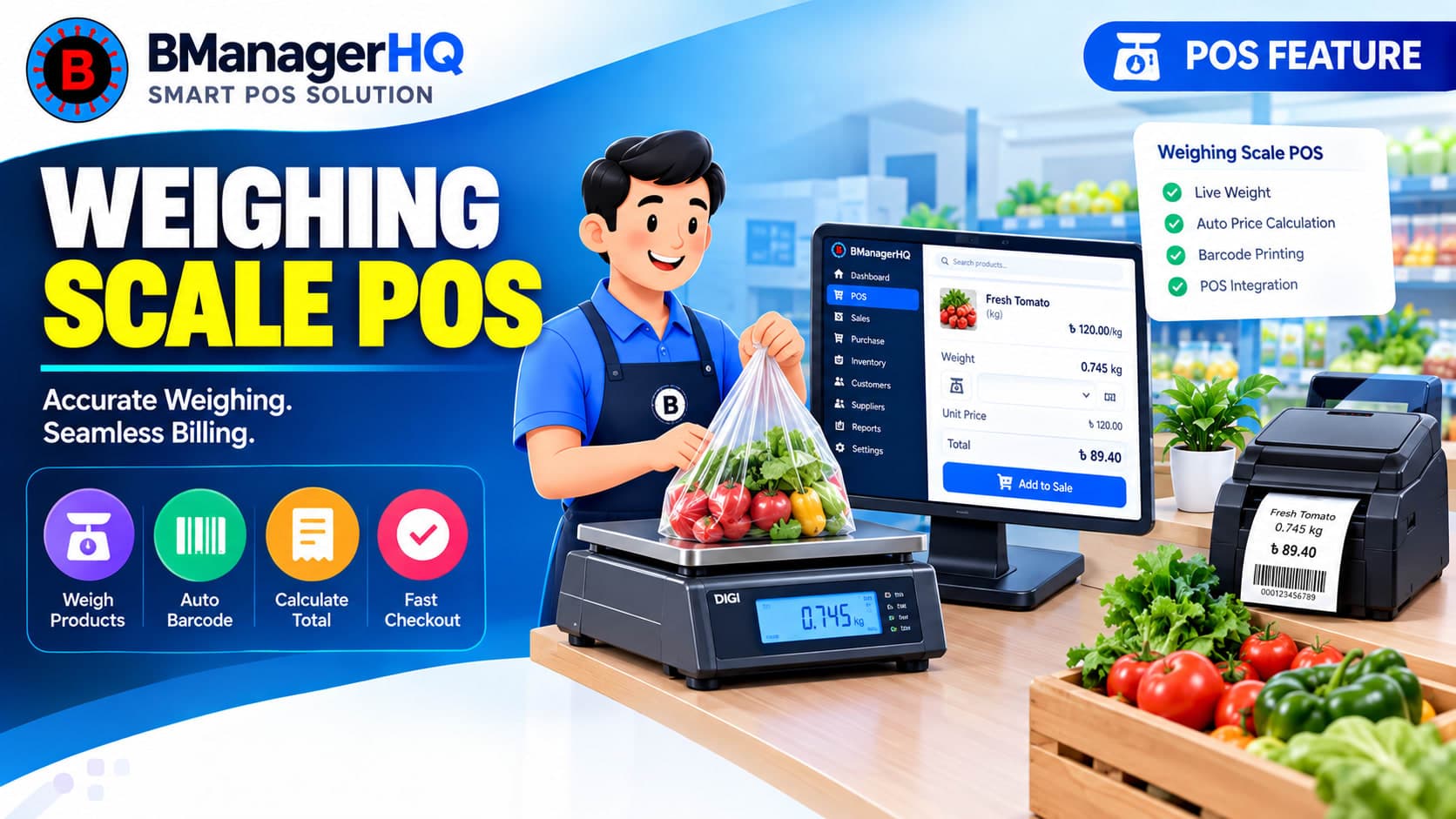
At a busy sales counter, manually measuring a product and then typing the quantity into the POS can add unnecessary steps. Weighing scale support can help create a smoother workflow where the measured quantity becomes part of the sales process.
This can make weight-based transactions easier to process, particularly during busy periods.
Accurate Quantity-Based Sales
Weight-based products require quantities to be handled differently from ordinary products. If an employee accidentally enters 2 instead of 2.5 kg, the resulting sale can be incorrect. Using a weighing-scale-oriented workflow helps businesses work with the actual measured quantity rather than relying entirely on manual quantity entry.
This can contribute to:
Better sales accuracy
More consistent billing
Faster transaction processing
Better product quantity records
Reduced manual entry
Combine Weighing Scale Support With Product Management
Weighing scale functionality becomes more useful when combined with proper product management. A business can organize its product catalog and identify products that are sold according to weight.
For example, a product catalog may contain different types of products with different selling methods:
Product Type
Example Sales Quantity
Unit-based product
2 pieces
Weight-based product
1.75 kg
Weight-based product
500 grams
Unit-based product
1 box
This allows the business to manage different types of products within the same POS environment.
When a product is sold by weight, the quantity removed from inventory should reflect the quantity actually sold. For example, if a business has a quantity of stock measured in kilograms and sells 1.5 kg, the inventory quantity needs to account for that weight-based transaction. This makes weighing-scale support particularly relevant to inventory management.
Businesses can combine weight-based sales with their broader inventory workflow to maintain better visibility of stock quantities.
A small shop may initially handle weight-based products manually. As transaction volume increases, however, manual processes can become more difficult to maintain consistently. A POS system that supports weighing-based transactions can help businesses standardize the sales process.
This becomes especially useful when:
Multiple employees operate the sales counter
The business processes many daily transactions
Product quantities vary from customer to customer
The business sells many weight-based products
Inventory needs to be monitored regularly
For businesses with multiple locations, weighing-scale sales can also form part of a centralized POS and inventory management workflow.
Weighing-scale sales are still part of the normal POS sales process. That means businesses can combine weight-based selling with cashier session management.
For example:
A CASHIER starts a sales session.
A customer selects a weight-based product.
The product is weighed.
The measured quantity is used for the transaction.
The sale is recorded.
The transaction becomes part of the cashier's sales activity.
This provides a more structured workflow for businesses where weight-based products are regularly sold at the counter.
This means weight-based selling does not need to exist as an isolated process. Instead, it can work alongside the business's existing product, sales, inventory, cashier, and reporting operations.
For example, a grocery business can manage its products, process weight-based sales at the counter, maintain inventory records, and review sales information through its broader POS system.
Why Weighing Scale Support Matters
For businesses selling products by weight, the quantity sold can change with every transaction. A POS system needs to accommodate this difference.
Weighing Scale Support provides a more appropriate workflow for these businesses by bringing measurement and sales processing closer together.
Whether you operate a grocery store, supermarket, food retail business, or another weight-based retail operation, integrating weighing into the POS workflow can help create more consistent and organized sales operations.
Manage Weight-Based Sales With BManagerHQ
If your business sells products by weight, your POS system should be able to accommodate variable quantities without making the sales process unnecessarily complicated.
BManagerHQ brings Weighing Scale Support together with product management, sales, inventory, cashier operations, and reporting to provide a more structured POS workflow for weight-based businesses.
Connect Your Weighing Scale to Your Sales Workflow
Make selling weight-based products faster and more accurate with weighing scale support built into your operations. With BManagerHQ Weighing Scale Support, you can record product weights, calculate prices accurately, and reduce manual entry during checkout.
It is functionality that allows a POS workflow to handle products sold according to measured weight rather than only fixed unit quantities.
Which businesses need weighing scale support?
Grocery stores, supermarkets, food retailers, and other businesses that regularly sell products by weight can benefit from this functionality.
Can I sell products by kilograms?
Yes, weight-based products can be handled as part of the weighing-scale sales workflow.
Can weighing scale sales work with inventory management?
Yes. Weight-based transactions can be incorporated into the broader product and inventory management process.
Does weighing scale support work with cashier sessions?
Yes. Weight-based sales can form part of normal cashier and POS session operations.
Can multi-location businesses use weighing-scale POS operations?
Yes. Businesses operating multiple shops, branches, or warehouses can incorporate weight-based sales into their broader multi-location POS workflow.
Scan product barcodes and create barcodes for products with BManagerHQ POS software. Speed up checkout, identify products quickly, and improve product and inventory management.